“You have cancer.”
The next fourteen months stripped away almost everything I thought made me myself.
My hair came out in the shower. I spent nights sleeping beside the bathroom after chemotherapy. Some days, walking to the mailbox felt impossible.
On the worst nights, I called my mother just to hear a familiar voice.
But eventually, even that stopped.
“Sweetheart, I have an early morning,” she would say.
So I learned to survive most of it alone.
That was why, when my oncologist finally smiled and said:
“Nora, there’s no evidence of disease.”
…I called my family first.
Mom promised to bring flowers.
My sister Paige said she would film me ringing the victory bell.
My brother Dean offered to drive me home.
“Wouldn’t miss it,” Mom said.
I bought a new dress.
The first thing I had bought purely for myself in more than a year.
But fifteen minutes before the bell ceremony, the messages started arriving.
Mom:
“Paige needs help with the kids. Sorry.”
Paige:
“It’s just a bell, Nora. Don’t make such a big deal out of it.”
Dean said work was crazy.
I called Mom.
“You promised.”
“You’re healthy now, aren’t you? Can’t you just be happy?”
Then I heard Paige laughing in the background.
They were together.
There were no separate emergencies.
They had simply decided not to come.
I hung up.
One of my nurses found me standing by the elevator.
“Nobody’s coming?”
I shook my head.
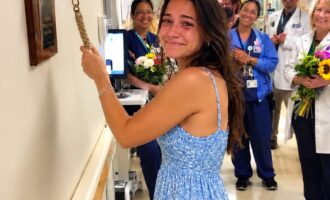
Ten minutes later, six doctors and nurses were gathered around the bell.
My oncologist had bought daisies from the hospital gift shop.
“No one should have to ring this alone,” he said.
I grabbed the rope.
Ding. Ding. Ding.
They applauded.
I cried so hard I could barely speak.
I was almost out through the hospital doors when my doctor came running after me.
“Nora, wait!”
My heart dropped.
“Is something wrong with my results?”
“No. Your results are fine.”
He pulled a folded document from his coat pocket.
“This is something else. And after what happened today, I think you deserve to know.”
My name was printed at the top.
Below it was my mother’s.
The document was a copy of a message the hospital’s financial office had received months earlier.
My doctor explained that a local charity organization had contacted the hospital because my family had been raising money online “to pay for Nora’s chemotherapy and home care.”
There was only one problem.
Most of my treatment had already been covered by insurance.
And I had never authorized a fundraiser.
“How much did they collect?” I asked.
He hesitated.
“More than forty-six thousand dollars.”
I stared at him.
During treatment, I had paid for transportation, uncovered medication, groceries, and rent mostly on my own.
I had never received that money.
That afternoon, I searched my name online.
The fundraiser was still there.
Pictures of me during chemotherapy.
Updates written by my mother.
“Our Nora is fighting for her life. Every donation will help with treatment, food, and round-the-clock care.”
Hundreds of people had donated.
The linked bank account belonged to my mother.
When I confronted her, she denied it at first.
Then she said:
“We suffered through your cancer too.”
Paige added:
“We used some of it for family expenses. It’s not like we stole from a stranger.”
I could barely believe what I was hearing.
“You raised money using my cancer and spent it without telling me.”
Dean said nothing.
Later, I learned that he knew about the fundraiser but had genuinely believed the money was being used for my care.
He was the only one who apologized without trying to excuse himself.
I hired an attorney.
I also contacted the fundraising platform and gave them the hospital records.
The campaign was frozen while the donations were reviewed.
There was no dramatic arrest the next morning.
There were bank statements.
Lawyers.
Requests for records.
Months of uncomfortable questions.
And eventually, consequences.
My mother and Paige were required to return a substantial portion of the money to donors and enter a financial settlement covering the rest.
I stopped speaking to both of them for almost a year.
Dean slowly rebuilt his relationship with me.
Not because he was my brother.
Because he finally started showing up.
Follow-up appointments.
Moving day.
Birthdays.
Small things.
Real things.
A year later, I returned to the hospital for another checkup.
My oncologist smiled.
“Still no evidence of disease.”
As I walked past the victory bell, I realized something.
I had once thought beating cancer would be the hardest part of surviving.
It wasn’t.
The harder part was learning that getting my life back also meant deciding who deserved a place in it.
Sometimes surviving an illness saves you twice: first from what was destroying your body, and then from the people who only valued your pain when they could benefit from it.