The restaurant was warm, quiet and full of soft evening light.
Couples spoke in low voices. Families shared desserts. Glasses clicked gently at nearby tables, and the smell of roasted chicken, fresh bread and coffee floated through the room.
At a small corner table sat an elderly woman alone.
Her coat was old but carefully brushed. Her silver hair was pinned neatly, and beside her plate lay a small worn purse. She had eaten slowly, as if every bite mattered.
When the bill arrived, her hands began to shake.
She opened her purse and counted the coins inside.
Once.
Then again.
Then a third time.
The young waiter standing beside her pretended not to notice her embarrassment.
But the nearby tables noticed.
A woman turned her head.
A man whispered something to his wife.
The elderly woman lowered her eyes.
“I’m sorry,” she said softly. “I’m a little short.”
The waiter, Daniel, looked at the bill.
Then at her trembling hands.
“It’s all right,” he said gently. “I’ll take care of it.”
The woman looked up quickly.
“No, son. Please don’t. I didn’t come here to cause trouble.”
“You’re not causing trouble,” Daniel said. “Everyone deserves one peaceful dinner.”
Her eyes filled with tears.
“I used to come here years ago,” she whispered. “With my daughter. Before everything changed.”
Daniel gave her a kind smile and reached for the bill.
But then he stopped.
Something had slipped out from beneath her scarf.
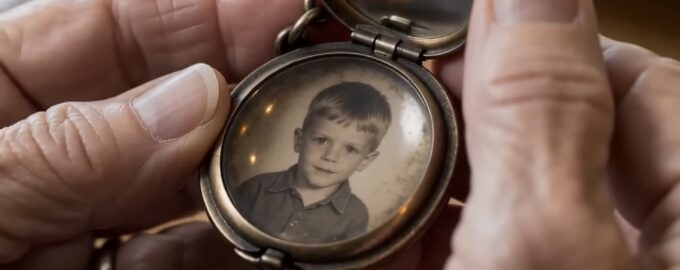
A small old locket.
It hung on a thin chain around her neck. The silver was darkened with age, and one side had a tiny scratch shaped like a crescent.
Daniel’s fingers froze.
The room around him seemed to fade.
“Wait,” he said quietly.
The woman touched the locket.
“What is it?”
Daniel’s voice changed.
“Where did you get that?”
The woman looked confused.
“This?” She held it between her fingers. “I’ve had it for many years.”
Daniel swallowed.
“May I… open it?”
The elderly woman hesitated.
Then slowly, with shaking hands, she opened the locket.
Inside was a tiny photograph of a little boy.
He was about four years old, with dark hair, serious eyes and a small scar above his eyebrow.
Daniel went pale.
The bill slipped from his hand and fell to the floor.
The woman looked frightened.
“What’s wrong?”
Daniel stared at the photograph.
“Where did you get my picture?”
The restaurant went silent.
The elderly woman stopped breathing for a moment.
“Your picture?”
Daniel pointed to the child inside the locket.
“That’s me.”
Her lips began to tremble.
“No,” she whispered. “That’s impossible.”
Daniel stepped back, confused and shaken.
“My adoptive mother had the same photo,” he said. “She told me it was the only thing I had when I was found.”
The elderly woman pressed one hand to her chest.
“What is your name?”
“Daniel Reyes.”
She shook her head slowly.
“No. No, your name was Mateo.”
The word hit him like a memory he had never been able to reach.
Mateo.
He had heard that name once in a dream when he was very young. A woman’s voice calling him from somewhere far away.
Daniel gripped the edge of the table.
“How do you know that?”
The elderly woman began to cry.
“Because Mateo was my grandson.”
The nearby tables were completely quiet now.
Daniel could barely speak.
“Your grandson?”
She nodded, tears falling down her cheeks.
“My daughter Sofia had a little boy. He disappeared after the night of the fire. They told us he had been taken to a hospital, but when I arrived, no one could find him. I searched for years.”
Daniel’s heart pounded.
“A fire?”
She nodded again.
“You had a little scar above your eyebrow. You hated carrots. You would only sleep if someone sang the same song twice.”
Daniel’s eyes filled.
His adoptive mother had told him he cried at night for years without knowing why.
The elderly woman reached into her purse and pulled out a folded, yellowed newspaper clipping.
With trembling fingers, she opened it.
There was a photo of a burned apartment building.
Under it was a headline about a missing child.
Daniel stared at the name printed beneath the photograph.
Mateo Alvarez, age four.
His knees almost gave out.
The restaurant manager hurried over.
“Daniel, are you all right?”
Daniel did not answer.
He looked at the elderly woman.
“What happened to my mother?”
The woman closed her eyes.
“She survived the fire for three days,” she whispered. “She kept asking for you. She made me promise that if I found you, I would tell you she never stopped looking.”
Daniel covered his mouth.
For years, he had believed he had been abandoned.
He had built his life around that wound.
His adoptive parents had loved him, but no one had been able to answer where he came from, why he had been found alone, or why a child’s photo had been tucked inside his baby blanket.
Now the answer sat in front of him at table seven, wearing an old coat and counting coins.
The elderly woman unclasped the locket from her neck.
“No,” Daniel said immediately. “Please don’t.”
But she placed it in his palm.
“I wore it for twenty-two years,” she said. “Every birthday. Every Christmas. Every time I thought I couldn’t keep searching anymore.”
Daniel’s hand closed around it.
“Why didn’t anyone find me?”
Her face twisted with pain.
“Your records were mixed after the fire. A volunteer took several children to another shelter when the hospital overflowed. By the time I traced the list, your name was gone. Someone had entered you as an unidentified child.”
Daniel looked down at the locket.
The boy in the photo looked back at him.
Not a stranger.
Not a ghost.
Him.
The manager quietly told the nearby guests to give them space, but no one moved for a moment. Many were crying.
Daniel pulled out the chair across from the woman and sat down.
“What is your name?” he asked softly.
She smiled through tears.
“Isabel.”
Daniel repeated it.
“Isabel.”
She reached for his hand.
“I know I have no right to ask for anything. I lost you. I should have found you.”
Daniel shook his head.
“You kept looking.”
Her fingers tightened around his.
“I never stopped.”
For the first time in his life, Daniel felt something inside him unlock.
The restaurant faded around them.
He was no longer just a waiter helping an elderly customer with a bill.
He was a man finding the missing beginning of his own story.
“Did my mother love me?” he asked.
Isabel’s face broke.
“More than anything in this world.”
Daniel closed his eyes.
Those words were enough to break him.
The manager quietly paid the bill himself. Then he brought coffee, tea and a slice of cake to the table without asking.
Daniel’s shift ended early that night.
He sat with Isabel until the restaurant was almost empty.
She told him about Sofia, his mother: how she sang while cooking, how she kept his drawings in a blue box, how she called him her little sunrise. She told him about his first steps, his first word, the toy train he refused to sleep without.
Daniel listened like a thirsty man drinking water.
Before they left, Isabel opened her purse again and pulled out a small key.
“This opens the old apartment storage room,” she said. “I kept everything I could save. Your mother’s letters. Your baby blanket. The blue box.”
Daniel stared at the key.
“You still have it?”
“I kept it for the day you came back.”
He looked at her.
“I didn’t come back,” he whispered. “You found me.”
Isabel smiled.
“No, Mateo. You found me when I had no money left for dinner.”
Daniel stood and helped her into her coat.
At the door, the cold evening air touched their faces.
For a moment, neither of them moved.
Then Isabel looked up at him.
“May I call you Mateo?”
Daniel’s eyes filled again.
He had been Daniel for most of his life.
But somewhere deep inside him, a lost child answered.
“Yes,” he whispered. “Just once.”
Isabel lifted a trembling hand to his cheek.
“My Mateo.”
Daniel bent down and hugged her.
Not politely.
Not carefully.
He hugged her like someone holding the piece of himself he thought was gone forever.
The next morning, he took Isabel to the storage room.
Inside, among dusty boxes and old photographs, he found the blue box.
On top was a letter from his mother.
The first line said:
“My son, if you ever read this, know that you were never unwanted.”
Daniel sat on the floor and cried.
Years later, he still worked in restaurants, but he never let an elderly customer leave embarrassed over a bill.
And every evening, under his uniform, he wore the old silver locket.
Not because it was valuable.
But because it carried the truth he had waited his whole life to hear.
He had never been abandoned.
He had been loved.
He had been searched for.
And at one quiet restaurant table, love had finally recognized him.